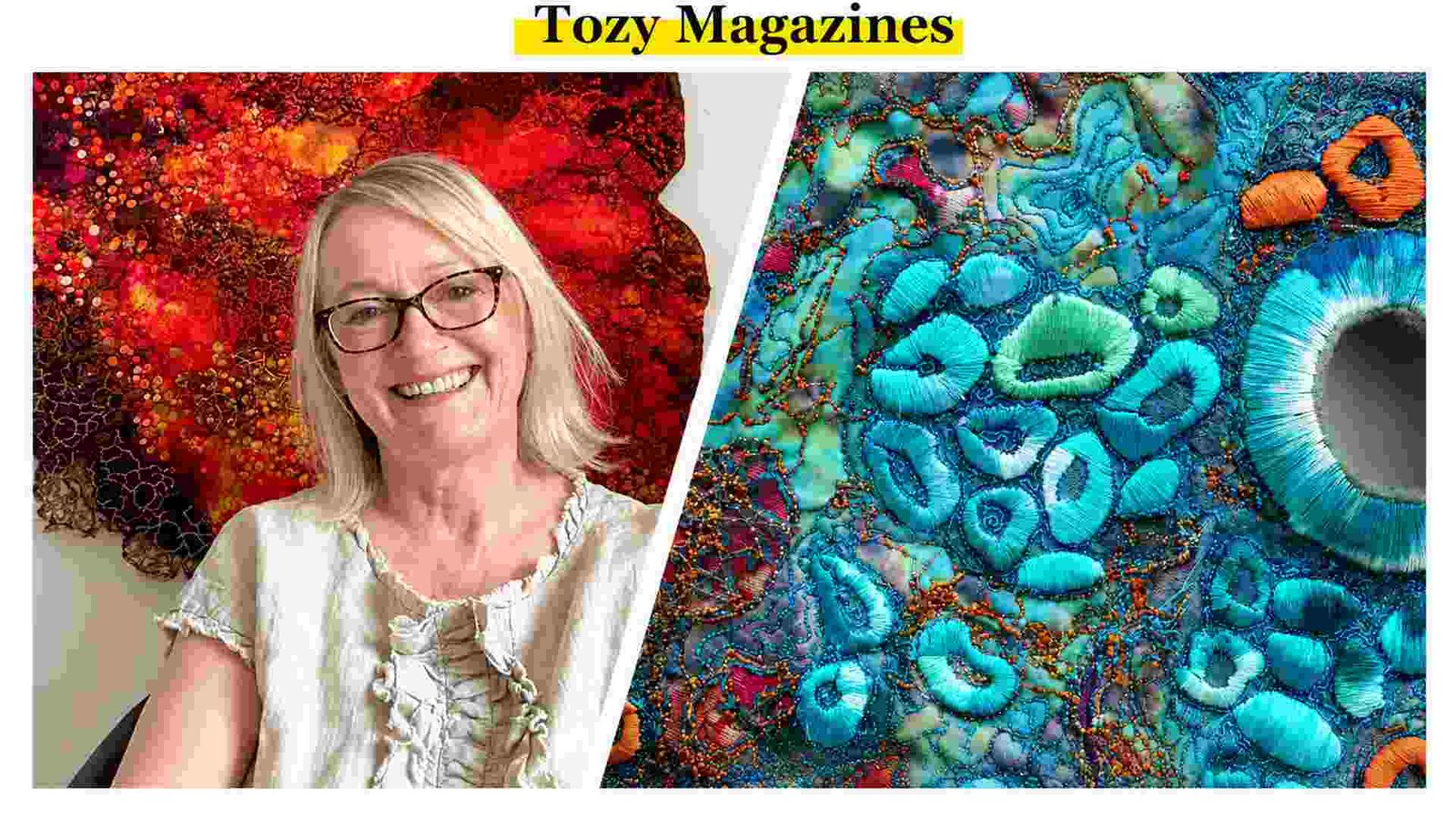
Sue Hotchkis is a British textile artist known for abstract work inspired by ageing, erosion, rust, peeling paint, and other worn surfaces. Based on the Black Isle in the Scottish Highlands, she combines print, stitch, dye, photography, layering, and fabric manipulation to build two- and three-dimensional textile pieces. Her work has appeared in exhibitions in the UK and abroad. In September 2026, her solo show Morphology of Decay is running at Timeless Textiles Gallery in Newcastle, Australia.
Here’s what to know about the artist behind those textured fragments. Hotchkis did not move straight from school into a full-time art career. She returned to education as an adult, trained in embroidery and textiles, taught for years, and then left teaching in 2007 to focus on studio work.
A Creative Childhood Came Before Art School
Sue Hotchkis grew up in the north of England. Making things was part of daily life from an early age.
Her father worked with wood and made furniture, while her mother made soft furnishings and clothes. Hotchkis also remembers her mother and grandmother sewing and knitting.
She had a small hand sewing machine when she was seven and used scraps of fabric to make clothes for dolls.
Art and needlework were favorite subjects at school. Yet she did not begin formal textile training as a teenager.
Her path took a turn first, and she spent years working for an electricity board. When voluntary redundancy became available, she used the change as a chance to study art.
She was in her late twenties when that new chapter began.
Manchester Metropolitan University Changed Her Direction
Sue Hotchkis started with a foundation course at Manchester Metropolitan University. That course helped her see how art and textiles could work together.
She went on to earn a BA with honors in Embroidery and later completed a master’s degree in Textiles at the same university.
Her studies gave her two tools that still shape her work: print and stitch.
During her degree, she took a print workshop. Later, a tutor pushed her to use print more heavily during her master’s work. Hotchkis has said the challenge changed her practice.
Print and stitch became partners rather than separate skills, and she also earned a postgraduate teaching qualification.
In a detailed TextileArtist interview, Hotchkis described that later start, her training, and the way print became central to her work.
Teaching Came Before Full-Time Studio Work
Before becoming a full-time artist, Hotchkis worked in education and taught art and textiles in Manchester. Her students included adults and people preparing for further art study.
Teaching kept her close to materials, design, and new ways of making. It also gave her time to build her own visual language.
In 2007, she left teaching and focused on her studio practice, but that decision did not mean starting from zero. She already had years of study, teaching, and making behind her.
It gave her more time to push one idea much further: finding beauty in things that are wearing away.
Decay Is the Starting Point, Not the End
Sue Hotchkis is drawn to surfaces that many people walk past.
She looks at rusted metal, torn posters, cracked plaster, faded walls, peeling paint, and marks left by weather or human use, because damage is not simply damage in her work. It creates pattern, color, line, and texture.
Her art often starts with photographs taken while she travels. Train stations, harbors, streets, and old buildings can all become sources.
She does not copy a wall or piece of metal exactly; instead, she takes the feeling and structure of the surface. She then builds a new abstract form in cloth.
That approach turns ordinary erosion into something worth looking at closely.
Wabi-Sabi Helps Explain Her View of Imperfection
Sue Hotchkis has spoken about the Japanese idea of wabi-sabi as an influence, a view that values change, age, imperfection, and things that do not stay fixed forever.
That fits naturally with her interest in worn surfaces.
A freshly painted wall can look smooth and complete. Years later, weather may lift the paint, expose older colors, and create cracks.
Hotchkis is interested in that second stage, and her work does not try to make decay look neat. It keeps the broken edges, layers, marks, and shifts that make the source interesting.
How Sue Hotchkis Builds a Textile Piece
Sue Hotchkis usually begins with plain material rather than commercial printed fabric.
She may dye cotton or work with synthetic fabrics such as voile and felt. She also uses paper in some pieces.
Photography often provides the first visual source, and she can turn her own images into screens for printing. Color and marks are then added to the cloth.
Stitch comes next, but there is no fixed recipe, as Hotchkis uses free-motion machine stitching and digital stitch. She may quilt, pad, layer, cut, tear, or distort the surface.
Heat can also change the fabric, and she has used a heat gun on synthetic material to make holes and rough edges. She stitches first because melted fabric can become too hard to sew.
The result can sit between a flat textile and a small sculptural object.
Why Her Work Is Often Called Fragments
Hotchkis often describes her abstract pieces as fragments, a word that fits the way they look and how they begin.
A fragment suggests that something larger existed before it. It may be a broken part, a worn section, or a piece that survived change.
Her works often have that feeling and can resemble pieces of a wall, sheets of corroded metal, or layers exposed over time. Yet they do not need to represent one real object.
Color is also important, because decay does not mean a dull brown surface. Hotchkis often uses strong color. Reds, blues, greens, and rust tones can become more intense than they were in the original photograph.
The work asks viewers to notice what time has added, not only what it has taken away.
The Black Isle Became Her Studio Base
Sue Hotchkis now works from the Black Isle in the Highlands of Scotland, a location that may sound far from the urban surfaces that often inspire her art. That contrast is part of the story.
She gathers ideas from travel and built places, then develops them in a quieter studio setting.
Her current EDGE Textile Artists Scotland profile lists the Black Isle as her base and describes her focus on ageing, decay, print, stitch, color, and surface.
She is also connected with wider textile networks. Hotchkis is a member of the international group Quilt Art and a Juried Artist Member of Studio Art Quilt Associates.
Those links place her work inside an international field of contemporary textile and fiber art.
Awards and Exhibitions Built an International Profile
Sue Hotchkis has shown work nationally and internationally, with a career that includes solo and group exhibitions, private commissions, books, magazines, and textile art events.
She won a silver medal at the Scythia International Biennial of Contemporary Textile Art in Ukraine in 2018. She also won Studio Art Quilt Associates’ Golden Hour fabric design competition in 2017.
Her work was selected for Quilt National ’23. The Dairy Barn Arts Center lists her piece Drought Of Honesty among the 2023 exhibitors.
She has also taken part in Quilt Art exhibitions.
In 2026, the QuiltArt exhibition Layers and Narratives ran at the Max Berk Textile Collection in Heidelberg, Germany. Museum listings used Hotchkis’s work Chrysalis as an image for the exhibition.
These events show how far her work has traveled from its everyday sources.
A 2026 Solo Exhibition Brings the Story Up to Date
Hotchkis has an active exhibition in September 2026.
Morphology of Decay opened at Timeless Textiles Gallery in Newcastle, Australia, on August 12, 2026. It runs through September 20.
The Timeless Textiles exhibition page lists works including Ferrous, Layers, Terra, Breakdown, and pieces from the Caught in the Mirror group.
The title fits the main idea that has followed Hotchkis for years.
Morphology means the study of form and structure. In this setting, the phrase points to the shapes and surfaces created as materials change and break down.
The gallery invites viewers to slow down and look at those shifts in color and texture.
For an artist who has spent years studying overlooked surfaces, the show feels like a direct extension of her long practice.
Sue and Susan Hotchkis Refer to the Same Artist
Readers may notice two versions of her first name.
Artist groups and interviews often call her Sue Hotchkis. Some gallery and exhibition listings use Susan Hotchkis.
They refer to the same textile artist based in the Scottish Highlands.
The work, education, and exhibition history match across those profiles.
This small detail can help when searching exhibition catalogs or gallery listings, where the formal version of her name may appear.
What Makes Her Work Different
Hotchkis does not use cloth simply as a surface for a picture.
She changes the cloth itself.
Printing adds one layer. Stitch adds another. Cutting, padding, heat, tearing, and lamination can change the shape and feel of the material.
The physical surface becomes part of the subject.
That is important because her source material is also physical. Rust lifts. Paint flakes. Metal pits. Paper tears.
Her methods allow the textile to show similar signs of stress and change.
The work is abstract, but the connection to real surfaces remains easy to feel.
Sue Hotchkis in 2026
Sue Hotchkis remains an active textile artist in 2026.
She works from the Black Isle, belongs to major textile art groups, and continues to show work internationally. Her current Morphology of Decay exhibition in Australia runs through September 20, 2026.
Her career also shows that an artist does not need one straight path.
Hotchkis worked outside art, returned to study as a mature student, taught for years, and then moved into full-time studio practice.
That path shaped work built around change itself.
She takes surfaces that look old, damaged, or finished and finds another life inside them. Print, stitch, color, and fabric turn those marks into new objects.
For another Tozy Magazines story about a creative woman whose life moved beyond one early career, read our profile of Jacqueline Malouf, who left acting and later found another outlet in painting.
