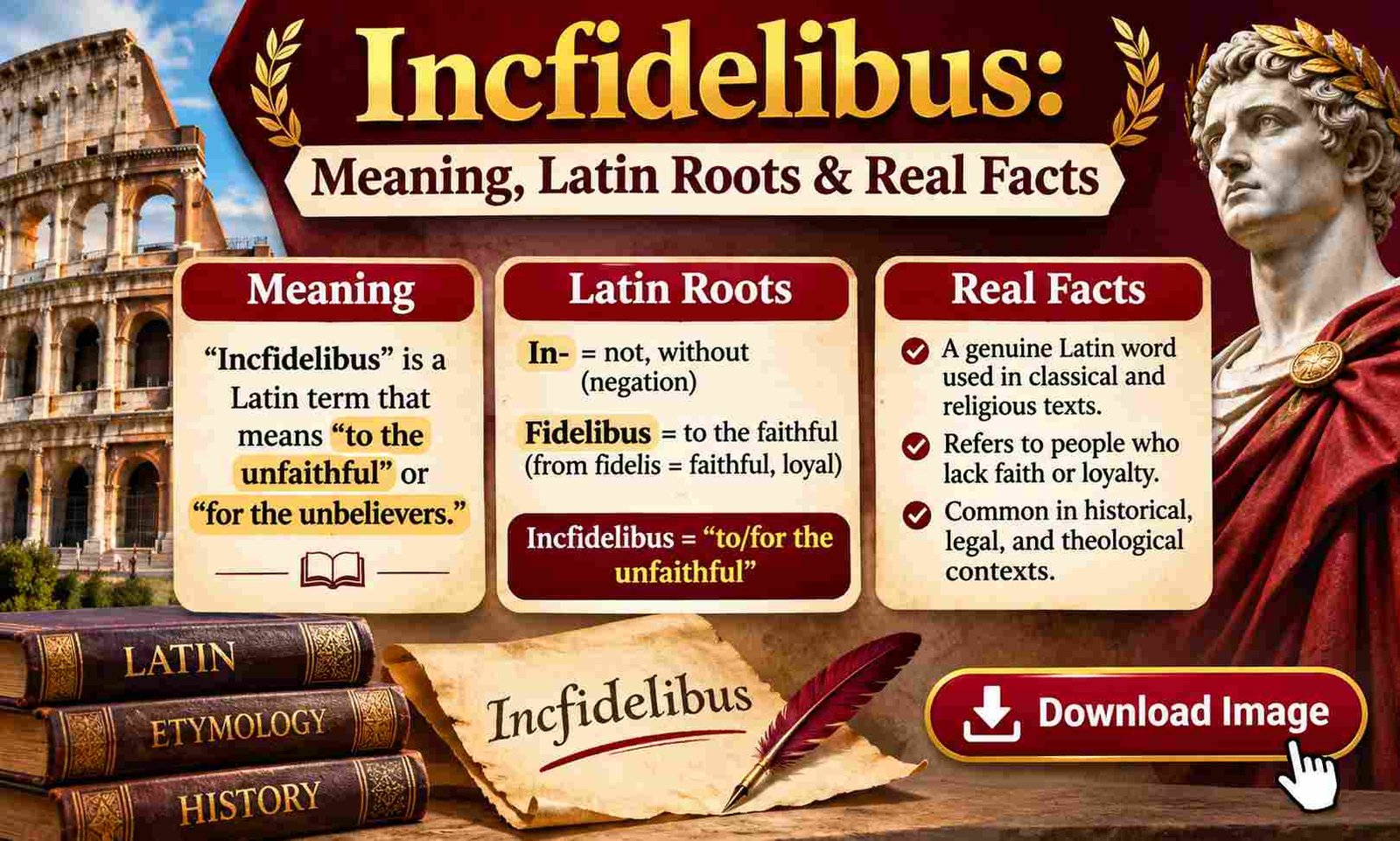
Incfidelibus is a rare term seen in online posts about trust, faith, and loyalty. It has no known meaning as a standard Latin or English word. The spelling is close to infidelibus, a real Latin form linked to being unfaithful or lacking belief. Some websites give Incfidelibus a deeper meaning, but there is no clear proof that it was an ancient idea or a formal school of thought.
A single letter can change how we read a word. In this case, one extra letter has led to a mix of claims about love, trust, history, and even online safety. The real story is more useful than the myths.
In this article, you’ll discover what Incfidelibus means, its link to Latin, why people connect it with trust and loyalty, and how to tell real facts from claims found online.
What Is Incfidelibus?
Incfidelibus is an unusual spelling that appears in online articles and search results.
It looks like a Latin word. Yet it does not have a clear place in standard Latin grammar.
The closest known form is infidelibus. That word comes from infidelis, which can mean unfaithful, disloyal, or lacking belief.
Some modern writers use the unusual spelling to discuss trust, honesty, and human bonds.
Those topics are real and worth exploring. Still, they do not prove that the spelling has its own old meaning.
The safest way to read it is as a nonstandard form whose meaning depends on its use.
Is Incfidelibus a Real Latin Word?
There is no strong evidence that Incfidelibus is a standard Latin word.
Latin has clear rules for how words change their form. The spelling with the extra letter c does not match the known form.
The real Latin word is infidelibus.
It is a plural form of infidelis. The exact English meaning depends on how it is used in a sentence.
For example, it may refer to people who are not loyal or who do not share a belief.
Latin word lists and grammar guides support this form. They do not give the same status to Incfidelibus.
This is why spelling matters when we study old texts.
The Latin Roots Behind the Term
To see why the word has links to trust, we need to look at its roots.
The Latin noun fides means faith or trust.
From that root comes fidelis, which means faithful or loyal.
The form infidelis adds a sense of not being faithful.
Then Latin grammar changes the word to fit its place in a sentence.
| Latin Word | Basic Meaning |
|---|---|
| Fides | Faith or trust |
| Fidelis | Faithful or loyal |
| Infidelis | Unfaithful or disloyal |
| Infidelibus | A plural form of infidelis |
| Incfidelibus | Nonstandard spelling |
This word family helps explain why modern articles discuss faith and loyalty.
It does not show that Incfidelibus was a unique ancient idea.
Why Do People Link Incfidelibus With Trust?
Trust is one of the main themes found in online writing about this term.
The link comes from the real Latin roots behind the similar word.
Trust is the belief that someone will act with care and honesty.
We rely on it in friendships, family life, work, and love.
For example, a friend may keep a secret because they value your trust. A worker may keep a promise because others depend on them.
These acts help people feel safe with one another.
Some writers use Incfidelibus to explore what happens when trust is lost.
That can be a useful theme for a story or essay. But it is a modern use, not a proven old definition.
Incfidelibus and the Meaning of Loyalty
Loyalty means staying true to a person, group, or set of values.
It often grows from care, respect, and shared trust.
A loyal friend may offer help during a hard time. A loyal team member may do their part even when the work is tough.
Yet loyalty should not mean blind support.
People can care for someone and still speak up when something is wrong.
This is an important part of healthy trust.
The Latin word fidelis has a clear link to being faithful. That helps explain the theme.
Still, we should not claim that Incfidelibus has been used for this idea since ancient times.
How Betrayal Fits Into the Discussion
Betrayal takes place when someone breaks trust in a serious way.
It may involve a lie, a broken promise, or an act that causes harm.
The pain often comes from the bond that existed before the act.
For example, a person may feel hurt when a close friend shares private news without consent.
The issue is not just the news itself. It is the loss of faith in that friend.
Some online posts place betrayal at the heart of Incfidelibus.
This may help explain the word’s appeal to readers who enjoy moral themes.
But a link to betrayal does not make the term an official word for that act.
Does Incfidelibus Have an Ancient History?
Some websites describe the term as if it came from a long history of moral thought.
Such claims need care.
There is no clear ancient text that proves Incfidelibus was the name of a formal belief or philosophy.
The real Latin roots have a long history. They appear in writing about faith, trust, and loyalty.
That is not the same as proof for the newer spelling.
A modern writer can build an idea around an old word. That idea may have value.
Yet it should be called a modern view unless old records support a deeper claim.
Good history begins with real sources, not a story that merely sounds old.
Why Has the Word Appeared Online?
Rare words can draw attention because people want to know what they mean.
A reader may see an odd term in a post and search for it.
Then a website may offer an answer. More sites may write about the same word.
Soon, search results can show many pages about it.
That does not mean the word has become part of common speech.
It may only mean that more people are asking the same question.
Some pages also give the term broad meanings tied to life, faith, and the self.
These ideas can sound deep, but readers should ask where the claims came from.
A clear source is worth more than a long list of vague claims.
Is Incfidelibus Linked to Phone Monitoring?
Some online results also link the name with claims about phone tracking and monitoring tools.
This is a very different topic from Latin grammar.
A name used for a website or service does not prove that the service is safe or legal.
Phone monitoring can raise serious privacy concerns, especially when someone has not agreed to it.
If you find a service that claims to read private chats or track a phone, be careful.
Do not share passwords or personal data with an unknown site.
Look for clear facts about the service and check local laws before using any monitoring tool.
The word itself is not a reason to trust a product.
How to Check the Meaning of a Rare Word
You can use a few easy steps to test a word you do not know.
First, look it up in a trusted dictionary.
If it seems to come from Latin, use a Latin word list or grammar guide.
Next, check the spelling. One extra letter may lead to a false result.
Then look for old records that show how the word was used.
Do not rely on one blog post. Compare sources and check whether they give proof.
If a page makes a bold claim with no clear source, treat it with care.
This habit can help you learn more and avoid false facts.
What Can We Learn From Incfidelibus?
This unusual term gives us a useful lesson about words and truth.
A word may look old, sound deep, and appear on many sites. None of those things proves its history.
At the same time, the real roots behind it can lead to good questions.
Why do we value trust? What makes a person loyal? How do we deal with a broken promise?
These are real parts of human life.
We can explore them without giving a rare spelling a false past.
That is the best way to enjoy new ideas while staying close to the facts.
Frequently Asked Questions (FAQs)
What Does Incfidelibus Mean?
It has no confirmed meaning as a standard Latin or English word. It is close to infidelibus, a Latin form linked to a lack of faith or loyalty.
Is Incfidelibus a Correct Latin Word?
No standard Latin form with that spelling has been established. The extra c makes it different from the real word infidelibus.
What Does Infidelibus Mean in English?
It can mean “to the unfaithful” or “with the unbelieving,” based on the grammar and the full sentence.
Is Incfidelibus an Ancient Philosophy?
There is no reliable proof that it was the name of an ancient school of thought.
Why Is Incfidelibus Linked to Trust and Betrayal?
The link comes from the real Latin roots tied to faith and loyalty. Modern writers use those ideas to discuss human bonds.
Final Thoughts
Incfidelibus may look like a word with a long past, but its true story is less clear.
The closest real Latin form has links to faith, trust, and loyalty. The spelling with the extra letter does not have the same proven status.
That difference is small on the page, yet it matters when we seek the truth.
The themes tied to the word can still teach us something. Trust grows through care. Loyalty needs respect. And facts need proof.
The best lesson is to stay curious, ask good questions, and never let a fine-sounding word take the place of truth.
