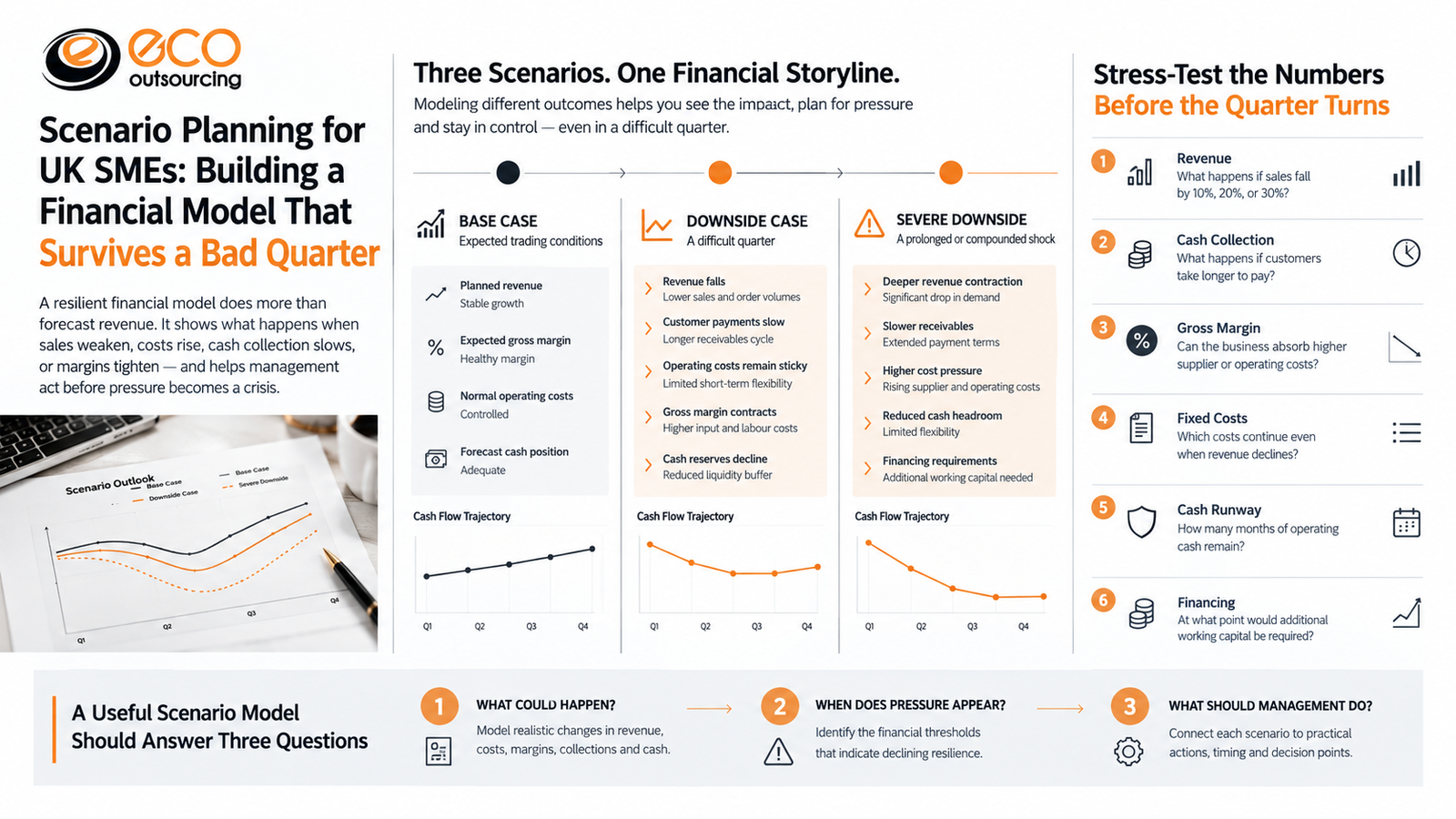
Sales dip in March. Your biggest customer pays three weeks late. A supplier puts prices up, payroll goes out on the 28th, and the VAT bill lands the following week. Your accounts still show a profit, yet the bank balance keeps sliding. Many SMEs meet exactly this problem, and most don’t have a full FP&A team to spot it early. That’s why more owners now look at financial analysis outsourcing as a way to get proper forecasting without building a finance department.
The fix starts with a better model. A good one doesn’t just tell you what you expect to happen. It shows how much cash you’d have if your assumptions broke, when the pressure would arrive, and what you’d do about it.
What Is Scenario Planning for a UK SME?
It means modelling several plausible versions of the future, so you can prepare before any of them arrive. You’re not predicting. You’re asking what could happen, how badly it would hurt, when the damage would show up in cash, and what you’d do.
The terms often get muddled, so here’s the difference:
| Tool | Question it answers |
| Budget | What do we plan to earn and spend? |
| Forecast | What do we expect to happen right now? |
| Scenario planning | What if key assumptions change? |
| Sensitivity analysis | What if one variable moves? |
| Stress test | Could we survive a severe but plausible shock? |
Why a Normal Forecast Fails in a Bad Quarter?
A standard forecast usually runs one line of expectation. It looks reassuring until reality departs from it.
Profit isn’t cash. Picture a firm with £100,000 of revenue and £15,000 of profit. If £50,000 of that revenue sits in unpaid invoices, the business can’t pay wages with it. Profit measures performance. Cash pays the bills.
Timing does the damage. Customers pay when they choose to. Payroll, VAT, PAYE and loan repayments arrive on fixed dates. A profitable business can still come up short for three weeks in the wrong month.
That’s why you need to find the cash trough, the lowest point your balance reaches. A healthy year-end figure means nothing if you run dry in week ten.
What Your Model Needs?
Keep it practical. A useful SME model connects the operating business to the bank account, so include:
- Revenue drivers: customers, volumes, pricing, contracts, seasonality, and how much rests on your top few clients
- Gross margin: growth that erodes margin can drain cash faster than a slow quarter
- Fixed and variable costs: salaries, rent and software on one side, materials and subcontractors on the other
- Working capital: debtor days, creditor days, stock and payment terms
- Payroll and tax: hiring plans, employer costs, VAT, PAYE, National Insurance, corporation tax
- Debt: repayments, interest and any credit facilities
Then run it all through one simple chain: opening cash, plus receipts, minus payments, equals closing cash. Do that weekly or monthly, and the trough shows itself.
Build Three Scenarios, Not Thirty
Most SMEs need three, and no more.
The base case is your most realistic current expectation. It isn’t the optimistic one.
The downside case tests things going wrong: lower sales, tighter margins, slower payers, dearer suppliers. Ground your assumptions in evidence. Look at past performance, your live pipeline, how customers actually behave and how concentrated your revenue is.
The growth case matters too. Faster sales mean hiring before revenue arrives, buying stock, and carrying bigger receivables. Success can strain cash just as badly as a slump.
Stress-Test Problems Together
Here’s where most models fall short. “Revenue drops 20%” is a tidy test. Real life is messier.
Try this instead: revenue falls 15%, your largest customer pays 30 days late, supplier costs rise, the new hire starts on schedule and VAT falls due. Each problem alone is survivable. Together, they may not be.
Test the specific risks too. What if your biggest client leaves, or cuts orders by a quarter? What if customers stretch 30 to 60 days late? What if costs climb while revenue falls? Keep the shocks severe but believable. A scenario so extreme that nobody acts on it helps nobody.
Use Two Time Horizons
A 13-week cash forecast covers immediate liquidity: payroll, supplier payments, VAT and the next invoices due in. A 12 to 18 month rolling forecast handles bigger decisions like hiring, pricing, investment and capacity. They answer different questions, so run both.
A Worked Example
Take a fictional Manchester distributor. It turns over £250,000 a month at a 40% gross margin, carries £85,000 of fixed costs, and starts the quarter with £150,000 in the bank. Customers pay in 45 days.
Base case: profit runs at roughly £15,000 a month. After a £45,000 VAT payment, cash stays near £150,000.
Downside: revenue drops 15%, supplier prices squeeze the margin to 37%, and customers slip ten days later. The firm now loses about £6,000 a month, and slower collections lock up roughly £71,000. After VAT, cash bottoms out near £16,000 in week eleven. Tight, but alive.
Compound downside: add a £60,000 delay from the biggest customer and a planned £4,000-a-month hire. The trough drops to around £56,000 overdrawn, and cash runs out about week eight.
That’s the number that changes decisions. Management now knows the danger date, and it’s early enough to act.
Turn the Model Into Action
A spreadsheet that doesn’t trigger decisions is decoration. Set your warning signs in advance, and give each one an owner and a deadline.
| Trigger | Action |
| Revenue falls 10% | Review the sales pipeline |
| Debtor days rise | Escalate collections |
| Cash drops below your floor | Cut discretionary spend |
| Hiring pushes cash below target | Delay the start date |
| Forecast turns negative | Talk to lenders early |
In the example, the distributor chases the largest overdue invoices, pushes the hire back two months and opens a conversation with its bank in week three. Not week eight. Lenders offer far better terms to a business that asks before it’s desperate.
Recovery deserves modelling too. Assume revenue returns gradually, costs normalise, and you rebuild cash before restarting hiring or investment. Most competitors’ models stop at the trough.
How Much Cash Should You Hold?
There’s no universal number. It depends on your fixed monthly costs, how volatile revenue is, customer concentration, payment terms, seasonality and access to finance. Your downside scenarios give you the answer: the minimum cash floor that keeps the business standing in a realistic bad quarter.
Mistakes That Sink Good Models
The repeat offenders are treating revenue as cash, modelling only the P&L, assuming everyone pays on time, and building one forecast instead of several. Others include testing a single variable, forgetting tax and payroll dates, and never checking forecasts against actuals.
Then there’s the model nobody updates. Refresh the 13-week view weekly, the rolling forecast monthly, and the scenarios quarterly. Update immediately after a lost customer, a big contract, a financing change or a supplier price rise.
The value of a financial model comes from the decisions it enables, not the number of tabs it contains.
When Should an SME Consider Financial Analysis Outsourcing?
Watch for the warning signs. Nobody knows which spreadsheet version is current. Forecasts don’t match the accounts. Assumptions live in someone’s head. Management only sees cash projections when the bank asks.
If that sounds familiar, and you don’t want the salary of a full-time FP&A hire, outsourcing may fit. It suits growing businesses that have outgrown bookkeeping but not yet justified a finance team. An internal hire gives you a dedicated person. Outsourced support gives you flexibility and no recruitment. Neither wins universally. It depends on your size, budget and how much modelling you need.
Frequently Asked Questions
Why can a profitable business run out of cash?
Profit counts a sale the moment it’s invoiced, not when the customer pays. Cash only arrives when the money actually lands. Payroll and VAT don’t wait for either.
How do you calculate the cash runway?
Divide available cash by your monthly net outflow to get a rough figure. Run the same sum through your downside scenario, since burn rate shifts once revenue and payment timing move.
How many scenarios should an SME model have?
Three usually does the job: base case, downside case and growth case. Adding more scenarios tends to make the model harder to maintain than useful.
What’s the difference between scenario planning and sensitivity analysis?
Sensitivity analysis changes one variable at a time, like a single price rise. Scenario planning tests several changes together, which is closer to how real disruption actually behaves.
When should an SME consider financial analysis outsourcing?
Once forecasts stop matching the accounts or nobody owns the spreadsheet, it’s a sign internal capacity has run out. Financial analysis outsourcing brings structured modelling in without the cost of a full-time hire.
Conclusion
A resilient model answers four questions. What could happen? When would the pressure appear? How much cash would remain? What would we do about it?
Nobody predicts a bad quarter perfectly. The aim is to see it early enough to choose your response rather than have it chosen for you. That’s the gap Eco Outsourcing exists to close, giving SMEs the forecasting and financial analysis outsourcing support to make that call with confidence rather than guesswork.
